
Is My Child Being Defiant, or Are They Overwhelmed?

Many parents wonder whether their child is being defiant or simply overwhelmed. While the behaviors can look similar, understanding the difference can help parents respond more effectively.
When Behavior Looks Like Defiance
Most parents think of defiance as intentional resistance. A child may:
Refuse to follow directions
Argue about rules
Talk back
Ignore requests
Do the opposite of what was asked
While these behaviors may be intentional at times, behavior does not always tell us the whole story.
Before assuming a child is choosing not to cooperate, consider asking:
"Can they do what I'm asking right now, or are they struggling to cope?"
As we discuss in our blog on The Power of Co-Regulation, children often need support regulating their nervous systems before they can access problem-solving skills or follow expectations.
What Overwhelm Can Look Like in Children
When children are overwhelmed, they often struggle to manage emotions, solve problems, and follow directions. Research shows that stress can affect a child's ability to regulate emotions and behavior, leading to reactions that may look like defiance.
Signs of overwhelm may include:
Meltdowns over small problems
Crying or shutting down
Difficulty transitioning between activities
Irritability
Trouble following directions
Avoiding difficult tasks
Emotional outbursts after school
What looks like defiance may actually be a sign that a child is stressed, overloaded, or lacking the skills needed to handle the situation.
If your child frequently struggles with emotional regulation, our free parent guide on How to Help Your Child Calm Down offers practical strategies parents can use at home.
Why ADHD, Anxiety, and Neurodivergence Matter
Children with ADHD, anxiety, autism, and other neurodivergent traits may become overwhelmed more easily.
Executive functioning challenges can make it difficult to:
Start tasks
Stay organized
Manage frustration
Remember directions
Shift between activities
Similarly, anxiety may show up as avoidance, arguing, refusal, or emotional outbursts rather than obvious worry.
When demands exceed a child's current abilities, what appears to be defiance may actually be overwhelm.
To learn more, explore our blogs on Understanding ADHD in Childrenand How to Help a Teenager with Anxiety.
How to Tell the Difference
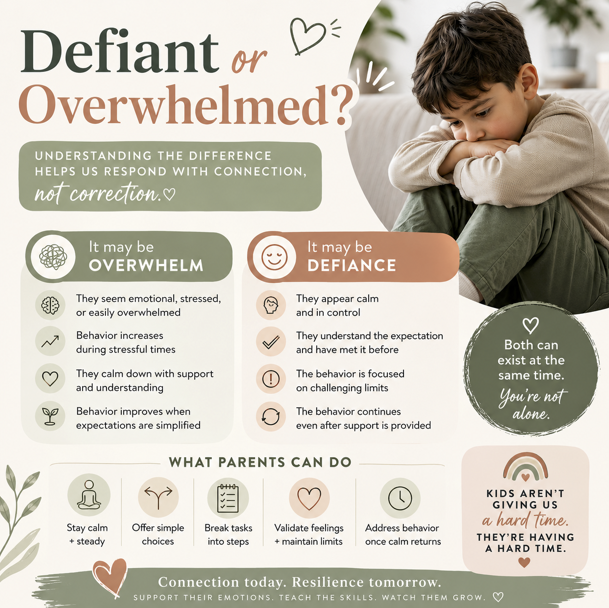
It may be overwhelm if:
The behavior increases during stressful times.
Your child seems emotional, tearful, or panicked.
The task is complex or has multiple steps.
They calm down when given support.
The behavior improves when expectations are simplified or clarified.
It may be defiance if:
Your child appears calm and in control.
They understand the expectation and have met it before.
The behavior is focused on challenging limits.
The behavior continues even after support is provided.
It's important to remember that both can exist at the same time. A child may be overwhelmed and still need accountability for their choices.
What Parents Can Do
Before addressing behavior, focus on helping your child regulate.
Try:
Staying calm and keeping your voice steady
Reducing unnecessary demands in the moment
Breaking large tasks into smaller steps
Offering simple choices
Validating feelings while maintaining limits
Addressing behavior once everyone is calm
Supporting emotions does not mean lowering expectations. It means helping your child develop the skills needed to meet them.
Parents often find it helpful to learn more about setting limits while remaining connected. Our blog, Four Strategies for Setting Limits With Your Kids, explores how to balance empathy and boundaries.

When Therapy Can Help
Sometimes children need additional support developing the skills necessary to manage emotions, cope with stress, and navigate challenges successfully.
Play therapy helps younger children express emotions through play, while counseling can help older children and teens build coping skills, emotional regulation, confidence, and problem-solving abilities.
Many children are not trying to be difficult. They are communicating stress, anxiety, frustration, or overwhelm in the best way they know how. With the right support, they can learn healthier ways to express their emotions and respond to life's challenges.
If you are concerned about your child's behavior or emotional well-being, learn more about our Child Therapy Services. You can also contact us to schedule a free consultation to discuss your family's needs and determine whether counseling may be a good fit.
Resources: https://www.mayoclinichealthsystem.org/hometown-health/speaking-of-health/stressed-out-kidshttps://psychcentral.com/stress/signs-your-child-is-stressed-ways-to-helphttps://www.medicalnewstoday.com/articles/stress-in-children