
Understanding Twice Exceptionality (2e): When Giftedness and Challenges Coexist

Parenting is rarely simple. Parenting a twice-exceptional child can feel uniquely confusing and isolating.
You may notice remarkable insight, creativity, or advanced thinking in your child alongside struggles that do not seem to match their abilities. One day they surprise you with deep questions or impressive vocabulary. The next, they are melting down over homework, transitions, or emotional regulation. You may hear comments like, “They’re so smart. Why is this so hard?” or “If they just tried harder…”
If this sounds familiar, you may be parenting a twice-exceptional (2e) child.
What Does “Twice Exceptional” Mean?
A twice-exceptional (2e) child is both gifted and has one or more learning, developmental, emotional, or neurological differences.
According to Bridges Education Group, twice-exceptional children demonstrate high ability in one or more areas while also experiencing challenges such as:
Those who fall under this umbrella simply have a natural variation in how their brain works. This creates different experiences and understandings of the world and can also lead to differences in how they learn and communicate with others.
ADHD (Learn more in Understanding ADHD in Children.)
Autism spectrum differences
Learning disabilities (such as dyslexia or dysgraphia)
Anxiety or mood challenges
Sensory processing differences
Executive functioning difficulties

These strengths and challenges exist at the same time and interact with one another.
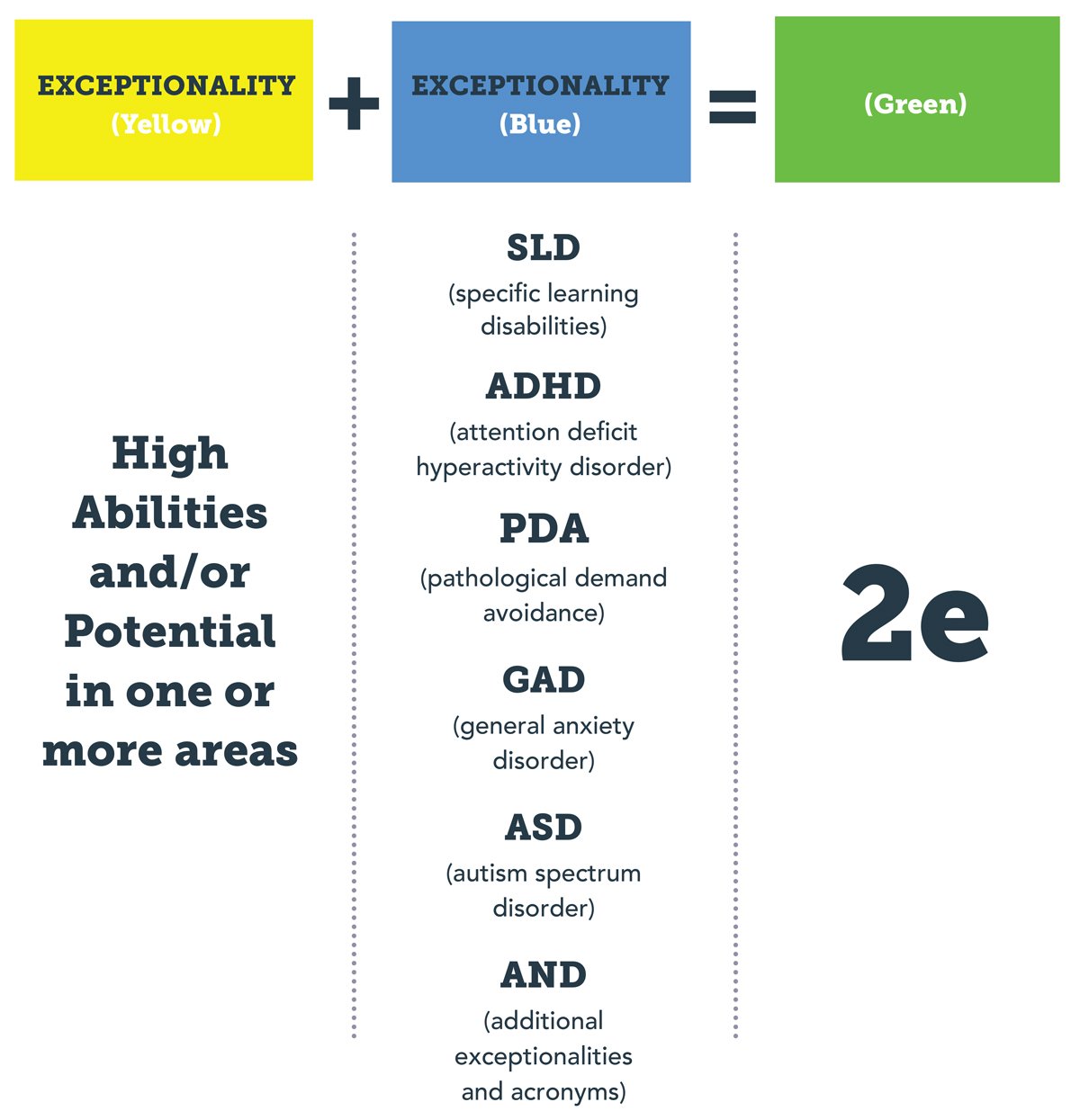
Source: Bridges Education Group – What Is Twice Exceptionality (2e)?https://bridges.edu/what-is-2e/
Why Twice Exceptionality Is So Often Missed
One of the hardest parts of twice-exceptionality is that strengths can mask challenges, and challenges can mask strengths.
A gifted child may compensate academically while struggling emotionally
A child with learning differences may never be recognized as gifted
Behaviors may be misinterpreted as defiance, laziness, or immaturity rather than signs of nervous system overload, anxiety, or executive functioning strain
If you have wondered whether your child's behavior is defiance or something deeper, Is My Child Being Defiant, or Are They Overwhelmed? offers a helpful framework.
As a result, many twice-exceptional children experience:
Late or missed identification
Inconsistent or inappropriate school support
For guidance on how to navigate school resources and advocacy, read How to Help Your Child At School: Navigating Resources, 504 Plans, and IEPs.
Confusion about expectations
Internalized shame or self-doubt
Many parents sense that something important is being missed, even when teachers or professionals are well-intentioned. Read more about how children can appear fine on the outside while quietly struggling in The Silent Struggles of 'Good Kids': Recognizing Hidden Anxiety and Depression.
What Research Tells Us About Twice-Exceptional Children
Recent research reinforces what many parents already know intuitively. Twice-exceptional children are at increased risk for emotional distress when their full profile is not understood.
A 2025 peer-reviewed study published in the Journal of Advanced Academics found that twice-exceptional students often experience:
Elevated anxiety and emotional overwhelm
Lower self-concept despite high ability
Increased likelihood of being misunderstood or under-supported in school settings
Greater emotional impact when strengths and challenges are addressed separately rather than together
The researchers emphasize that when giftedness and disabilities are viewed in isolation, or when one masks the other, children are more likely to internalize frustration, confusion, and self-blame.
For parents, this research validates an important truth. Uneven development is not a character flaw. When adults understand the whole child, including both strengths and struggles, children are more likely to feel seen, supported, and emotionally safe.
What Twice Exceptionality Often Looks Like at Home
Parents of twice-exceptional children frequently describe:
Intense emotions and big reactions
Perfectionism paired with avoidance or shutdown
Strong empathy or a heightened sense of fairness
Difficulty with transitions, expectations, or demands
Exhaustion from holding it together all day at school
A child who feels older than their age in some ways and younger in others
This push and pull can be deeply taxing for children and for parents. If big emotions and meltdowns are part of your daily reality, How to Help Your Child Calm Down: Effective Behavior and Coping Strategies offers practical tools you can use at home.

You’re Not Doing It Wrong. You’re Parenting a Complex Child.
If you have ever felt that:
Traditional parenting advice does not work
School feedback feels contradictory or incomplete
You are constantly advocating, explaining, or second-guessing
You love your child fiercely, but feel worn down
You are not alone, and you are not failing.
Twice-exceptional children need adults who understand both sides of the equation: their brilliance and their vulnerability. Our post on Parenting Neurodivergent Kids: Embracing Differences is a great companion read for understanding your child's full picture.
New at Reach Counseling: Virtual Parent Discussion Group for 2e Families
At Reach Counseling, we are excited to offer a virtual parent discussion group specifically for parents and caregivers of twice-exceptional children.
This group is designed to provide:
Education about twice-exceptional profiles
Research-informed understanding of emotional needs
Connection with other parents who truly understand
Practical tools grounded in nervous system awareness and child development
Compassion for your child and for yourself
This is a supportive, guided discussion focused on understanding, connection, and relief.
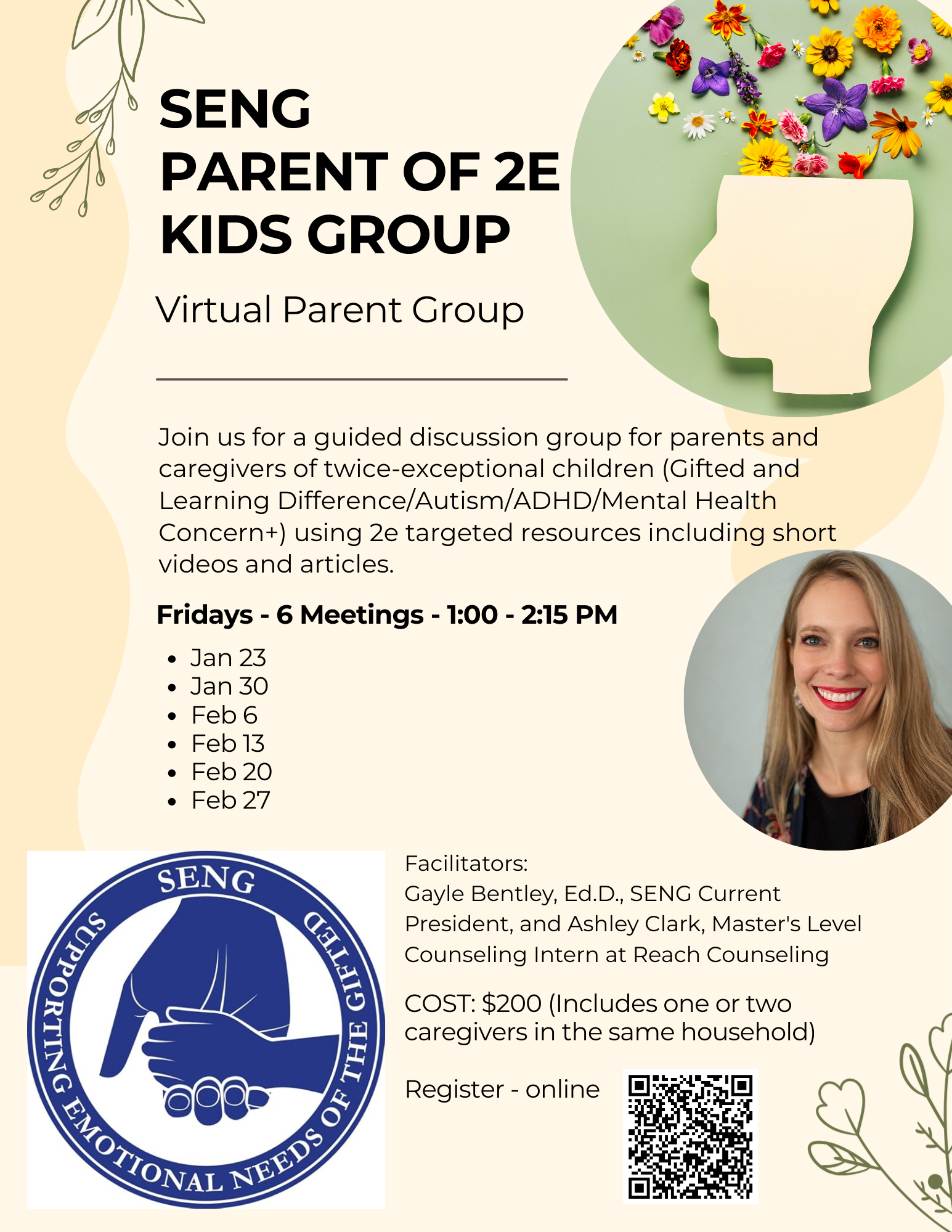
Group Details
This group is not currently running. Check out our current group offerings to find the right fit for your family.
Questions: Ashley@ReachCounselingTX.com
You Don’t Have to Navigate This Alone
Twice-exceptionality can feel overwhelming when you are carrying it by yourself. When parents find language for what they are seeing and community with others who recognize it, everything shifts.
If you suspect your child may be twice-exceptional, or if you are already living this reality and need support, we invite you to join us. Not sure if therapy is the right next step? Read How to Know if Your Child or Teen Needs Therapy to help you decide.
References
Bridges Education Group. (n.d.). What Is Twice Exceptionality (2e)?https://bridges.edu/what-is-2e/Reis, S. M., Baum, S. M., & Burke, E. (2025). Understanding the social and emotional experiences of twice-exceptional students. Journal of Advanced Academics.https://journals.sagepub.com/doi/10.1177/1932202X251387416