
How to Set Boundaries With Kids at Home (Without the Yelling)

If you've ever looked at your child mid-meltdown and felt your whole body brace before you said "no," you already know how hard this is. Learning how to set boundaries with kids at home is one of the most common things I work through with the families in my practice. Defiant behavior, aggression, big emotions that seem to come out of nowhere. Parents show up exhausted, not because they don't know their kid needs limits, but because they don't know how to set them without a fight breaking out every time.
Here's the good news: setting limits doesn't have to be a battle. There's a simple, three-step way to do it that actually helps kids respond better, not worse.
What Setting Limits Actually Looks Like at Home
In my work with kids and families, I see defiant, aggressive, and angry behaviors constantly. It's not unusual, and it doesn't mean something is wrong with your child or your parenting. It usually just means your child is overwhelmed and doesn't yet have the tools to handle what they're feeling.
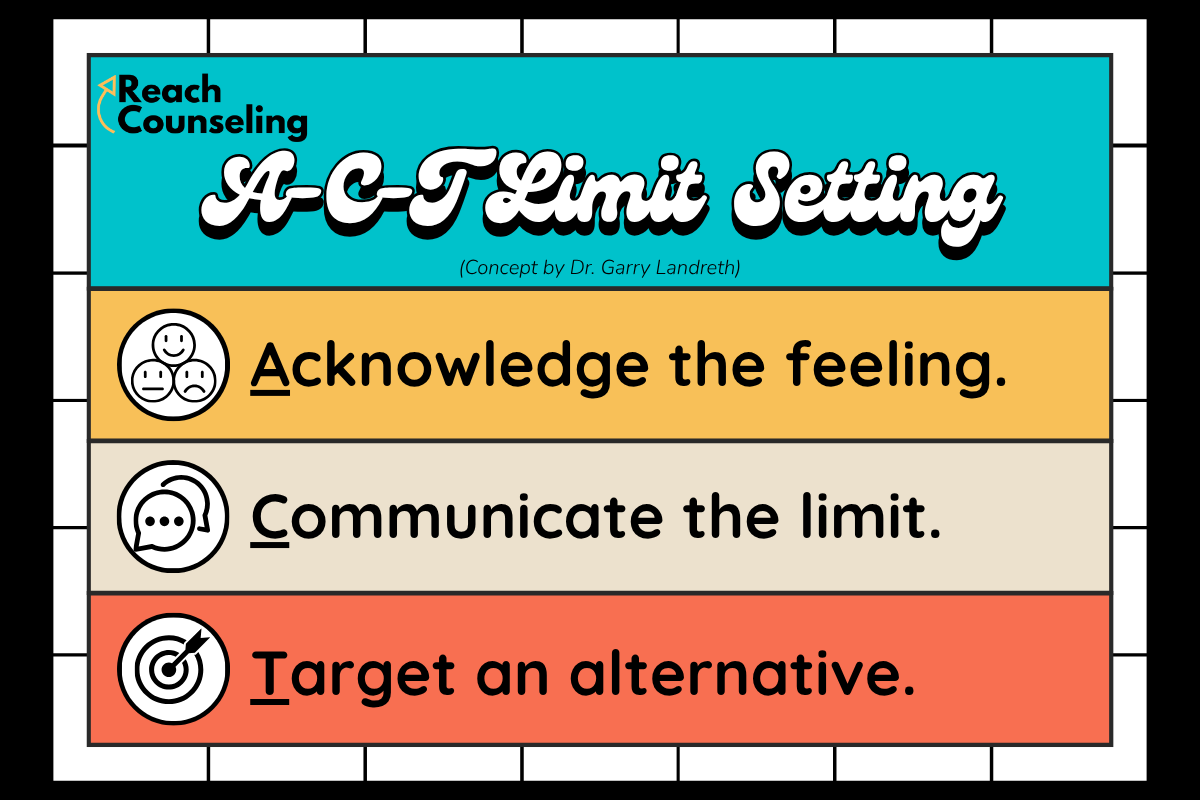
The framework I recommend to almost every family I work with is called ACT limit setting. It's a three-step process:
Acknowledge the feeling. Something like, "I understand you feel frustrated."
Communicate the actual limit. For example, "Your brother is not for hitting."
Offer an alternative. "If you need to get out your anger, you can hit a pillow or do jumping jacks."
Put together, it sounds like this: "I understand you feel frustrated, but your brother is not for hitting. If you need to get out your anger, you can hit a pillow or do jumping jacks."
That's it. Three sentences. But the order matters more than most parents expect.
Why Naming the Feeling First Changes Everything
Here's the clinical opinion I wish every parent heard before their next meltdown: the most important part of any limit isn't the limit itself. It's naming the emotion or desire underneath it first.
When you acknowledge what your child is feeling before you tell them what they can't do, it helps them feel seen and understood. And a child who feels understood is far more likely to actually respond to the limit you're setting, instead of just digging in harder.
I know this is hard to do in the moment. Our instinct is to stop the behavior the second we see it, not to pause and name a feeling first. Using ACT limit setting takes practice and patience. It will feel unnatural at first. But it's worth it.
Aggressive Play Isn't Always a Problem
In play therapy sessions, I see a lot of aggressive behavior with stuffed animals, punching bags, toy swords, and toy guns. Here's something that surprises a lot of parents: acting out aggressive behavior in play is actually a healthy sign. It usually means your child is working through big emotions, often related to anger or a need for power and control. That kind of play isn't something to shut down automatically.
But there are times when a limit genuinely needs to be set. A limit is always appropriate when a person, including the child themselves, is at risk of getting physically hurt. It's also common to set limits around damaging property, like toys, walls, or mirrors, and around inappropriate language, like cursing or insults.
In your own home, you get to decide where that line is. What counts as a limit-worthy moment will look different for every family, and that's okay.
The Biggest Misconception About Setting Limits
A lot of parents believe limits have to be delivered with some edge to them, more volume, more sternness, in order for a child to actually change their behavior. That's not true. The most effective limits are both firm and empathetic. Firm means stating the limit calmly and without hesitation, not stating it loudly.
There's a second misconception too: that limits need to be set constantly, ahead of time, before anything has even happened. In reality, limits aren't really needed until they're needed. The most effective and important time to set a limit is right after the behavior occurs, not preemptively for things that haven't happened yet.
If You're Feeling Stuck
If you're reading this in the middle of the night, dreading tomorrow's meltdown, here's what I want you to know: setting limits does not come naturally to most people, and that's not a flaw in you.
It can be genuinely hard to look at a child you love and tell them no. Your nervous system reacts to that moment because of how much you care. Most of the parents I work with struggle at first when they try ACT limit setting, because changing the way you respond to your child takes real practice.
You are not alone in finding this hard. Consistent limits at home make a real difference for kids — for practical, easy-to-implement strategies, check out our clinical director's post, Four Strategies for Setting Limits with Your Kids.
Start small. Next time your child does something that needs a limit, try the three steps: name the feeling, state the limit calmly, offer an alternative. It won't feel smooth the first few times. That's normal. It gets easier with repetition, for both of you.
You Don't Have to Figure This Out Alone
Setting boundaries at home is one of the hardest, most loving things you'll do as a parent. If you're finding it difficult to know where to draw the line, or your child's behavior feels bigger than what these tools can handle on their own, that's a good sign it might help to bring in some extra support.
If you're not sure where to start, we'd love to help you figure that out.

Riley Corder, M.S., LPC-Associate supervised by Carrie Manning, LPC-S
Riley specializes in working with young people (ages 3+) as well as adults using individual and group therapy. Riley has dedicated training in Child-Centered Play Therapy and the ACT Limit Setting Model.